WoRMS taxon details
Eleocharis parvula (Roem. & Schult.) Link ex Bluff, Nees & Schauer
715995 (urn:lsid:marinespecies.org:taxname:715995)
accepted
Species
Baeothryon nanum A.Dietr. · unaccepted
Chaetocyperus membranaceus Buckley · unaccepted
Chaetocyperus pusillus Steud. · unaccepted
Chaetocyperus pygmaeus (Torr.) Torr. ex A.Gray · unaccepted
Clavula comosa Dumort. · unaccepted
Cyperus parvulus Missbach & E.H.L.Krause · unaccepted
Eleocharis leptos (Steud.) Svenson · unaccepted
Eleocharis leptos var. johnstonii Svenson · unaccepted
Eleocharis membranacea (Buckley) Gilly · unaccepted
Eleocharis parvula (Roem. & Schult.) Palla · unaccepted
Eleocharis parvula f. spongiosa Fassett · unaccepted
Eleocharis parvula subsp. oppermannii Zoz · unaccepted
Eleocharis pygmaea Torr. · unaccepted
Eleogiton parvula Link · unaccepted
Isolepis leptos Steud. · unaccepted
Limnochloa parvula Rchb. · unaccepted
Scirpus comosus Dumort. · unaccepted
Scirpus comosus (Dumort.) B.D.Jacks. · unaccepted
Scirpus leptos (Steud.) C.Wright · unaccepted
Scirpus nanus Spreng. · unaccepted
Scirpus parvulus Roem. & Schult. · unaccepted
Scirpus pollicaris Delile · unaccepted
Trichophorum parvulum (Roem. & Schult.) Pignatti · unaccepted
- Forma Eleocharis parvula f. parvula (Roem. & Schult.) Link ex Bluff, Nees & Schauer accepted as Eleocharis parvula (Roem. & Schult.) Link ex Bluff, Nees & Schauer
- Forma Eleocharis parvula f. spongiosa Fassett accepted as Eleocharis parvula (Roem. & Schult.) Link ex Bluff, Nees & Schauer
- Subspecies Eleocharis parvula subsp. oppermannii Zoz accepted as Eleocharis parvula (Roem. & Schult.) Link ex Bluff, Nees & Schauer
- Variety Eleocharis parvula var. anachaeta (Torr.) Svenson accepted as Eleocharis coloradoensis (Britton) Gilly
- Variety Eleocharis parvula var. coloradoensis (Britton) Beetle accepted as Eleocharis coloradoensis (Britton) Gilly
- Variety Eleocharis parvula var. parvula (Roem. & Schult.) Link ex Bluff, Nees & Schauer accepted as Eleocharis parvula (Roem. & Schult.) Link ex Bluff, Nees & Schauer
(of Scirpus parvulus Roem. & Schult.) Linné, C. V.; Römer, J. J.; Schultes, J. A.; Schultes, J. H.; Sprengel, K. P. J.;. (1817). Caroli a Linné ... Systema vegetabilium :secundum classes, ordines, genera, species. Cum characteribus, differentiis et synonymiis. vol. 2, pp. 1-964., available online at https://www.biodiversitylibrary.org/page/719829#page/1/mode/1up
page(s): 124 [details]
page(s): 124 [details]
Description Plants connected by whitish capillary stolons creeping on the surface, often terminating in a small whitish tuber. Stems...
Description Perenne, laxamente cespitosa de porte muy reducido; raíces capilares; estolones horizontales muy finos, terminados en...
Description Tubers terminating rhizomes usually markedly J- or horseshoe-shaped, body (apart from apical bud) oblong, 2–2.5(–5) ×...
Taxonomic remark Source in seed data: wcs Update namepublishedIn from Comp. Fl. German. (ed. 2) [Bluff & Fingerhuth] 1(1): 93. 1836 [Jan...
Description Plants connected by whitish capillary stolons creeping on the surface, often terminating in a small whitish tuber. Stems 2–8 cm × 0.3–0.5 mm, sparsely tufted, terete, often spongy, smooth to minutely septate-nodulose when dry, often flowerless and leaf-like. Leaves reduced to bladeless sheaths up to 1 cm long, translucent, indistinct. Inflorescence a single, terminal, ovoid to ovoid-ellipsoid spikelet, 1.9–4 × 1–1.5 mm. Glumes 1.2–2.5 × 1–2 mm, up to 9 per spikelet, ovate, with an obtuse to acute apex and greenish to yellowish-brown striate margins and indistinct midrib, the lowest glume usually empty and half or more as long as the spikelet, completely surrounding its base. Flowers bisexual; perianth bristles usually 3, equalling or longer than nut; stamens 3, with their anthers 1.0–1.2 mm long; stigmas 3. Nuts 1.0–1.4 mm* long, obovoid, trigonous, pale yellowish, smooth to very minutely reticulate, shiny; style-base small, conical, confluent with nut. [details]
Description Perenne, laxamente cespitosa de porte muy reducido; raíces capilares; estolones horizontales muy finos, terminados en...
Description Perenne, laxamente cespitosa de porte muy reducido; raíces capilares; estolones horizontales muy finos, terminados en pequeños bulbillos ovoides, de color rojizo o blanquecino y hasta de 3 mm, de donde nace una nueva planta. Tallos (1,5)2–8(12) cm × 0,2–0,5(0,7) mm, capilares, rectos, estriados y surcados cuando secos. Vainas escariosas, frecuentemente rojizas hacia la base, que pueden estar deshilachadas o deschacadas prontamente. Espiguilla 2,8–3,5(3,8) mm, de contorno ovado, con 4–5 flores. Glumas (1,1)1,5–2 mm, en disposición subdística, ovado-lanceoladas, de color pardo-rojizo, con una banda verdosa en el centro y márgenes escariosos; la inferior suele alcanzar o superar la mitad de la longitud de la espiguilla y es estéril, muy rara vez fértil. Estambres 3; anteras 1–1,5 mm, amarillas, apiculadas, con el mucrón teñido de rojizo. Estilo 1–1,5 mm, con 3 estigmas, rojizo, persistente o tardíamente caedizo. Aquenios 1 × 0,3–0,7 mm, de contorno estrechamente obovado, trígonos, muy finamente reticulados, de color pardusco, oliváceo o pajizo, ± brillantes; estilopodio piramidal, atenuado en la zona de unión con el aquenio y delimitado del mismo por un minúsculo reborde, de color blanquecino, rojizo o negruzco; cerdas periantias 3–6, que sobrepasan al aquenio, retrorso-escábridas, blancas o rojizas. 2n = 10.* [details]
Description Tubers terminating rhizomes usually markedly J- or horseshoe-shaped, body (apart from apical bud) oblong, 2–2.5(–5) ×...
Description Tubers terminating rhizomes usually markedly J- or horseshoe-shaped, body (apart from apical bud) oblong, 2–2.5(–5) × 0.5–1 mm; tubers among culm bases straight, narrowly fusiform, 4–5 mm. Spikelets 2–4 × 1–2 mm, sometimes absent in deeper water; proximal scale 1/2 or more of spikelet length; floral scales 6–10 per spikelet, 1.4–2.7 mm, commonly entirely stramineous, apex rounded to subacute. Flowers: perianth bristles 6, stramineous, fairly stout to slender, usually equaling achene to slightly exceeding tubercle, sometimes unequal and some 1/2 of achene, very rarely rudimentary, minutely retrorsely spinulose; anthers 0.7–1.2 mm. Achenes stramineous, sometimes pale brown, obovoid to obpyriform, thickly trigonous, angles distinct, faces concave to plane, rarely convex, 0.9–1.2 × 0.55–0.75 mm, apex tapered, smooth or faintly rough at 30X. Tubercles 0.1–0.2 × 0.15 mm. 2n = 10 (Europe). [details]
Taxonomic remark Source in seed data: wcs Update namepublishedIn from Comp. Fl. German. (ed. 2) [Bluff & Fingerhuth] 1(1): 93. 1836 [Jan...
Taxonomic remark Source in seed data: wcs Update namepublishedIn from Comp. Fl. German. (ed. 2) [Bluff & Fingerhuth] 1(1): 93. 1836 [Jan 1836] to Comp. Fl. German. , ed. 2, 1: 93 (1836), information provided by Alan E. on email Jun. 07 2021 More details could be found [details]
Cyperaceae Working Group. (2026). [see How to cite]. Global Cyperaceae Database. Eleocharis parvula (Roem. & Schult.) Link ex Bluff, Nees & Schauer. Accessed through: World Register of Marine Species at: https://www.marinespecies.org/aphia.php?p=taxdetails&id=715995 on 2026-03-09
Date
action
by
2024-12-10 11:47:54Z
unchecked
db_admin
 The webpage text is licensed under a Creative Commons
Attribution 4.0 License
The webpage text is licensed under a Creative Commons
Attribution 4.0 License
Nomenclature
original description
(of Scirpus parvulus Roem. & Schult.) Linné, C. V.; Römer, J. J.; Schultes, J. A.; Schultes, J. H.; Sprengel, K. P. J.;. (1817). Caroli a Linné ... Systema vegetabilium :secundum classes, ordines, genera, species. Cum characteribus, differentiis et synonymiis. vol. 2, pp. 1-964., available online at https://www.biodiversitylibrary.org/page/719829#page/1/mode/1up
page(s): 124 [details]
basis of record PESI - Pan-European Species directories Infrastructure, available online at http://www.eu-nomen.eu/portal/ [details]
basis of record Plants of the World Online (POWO). , available online at https://powo.science.kew.org/ [details]
new combination reference Schauer, J. C. (1836). Compendium florae Germaniae. Sectio I, Plantae phanerogamicae seu vasculosae. 1., available online at https://www.biodiversitylibrary.org/page/6139595#page/7/mode/1up
page(s): 93 [details]
page(s): 124 [details]
basis of record PESI - Pan-European Species directories Infrastructure, available online at http://www.eu-nomen.eu/portal/ [details]
basis of record Plants of the World Online (POWO). , available online at https://powo.science.kew.org/ [details]
new combination reference Schauer, J. C. (1836). Compendium florae Germaniae. Sectio I, Plantae phanerogamicae seu vasculosae. 1., available online at https://www.biodiversitylibrary.org/page/6139595#page/7/mode/1up
page(s): 93 [details]
Taxonomy
taxonomy source
Jermy, A.C.; Simpson, D.A.; Foley, M.J.Y.; Porter, M.S. (2007). Sedges of the British Isles. 554 pp. Botanical Society of Britain & Ireland, United Kingdom. [details] Available for editors  [request]
taxonomy source Luceño, M., Castroviejo, S., Jiménez-Mejías, P. (2008). Cyperaceae. In: Castroviejo, Luceño, M., Galán, A., Jiménez-Mejías, P., Cabezas, F., Medina, L. (eds). Flora iberica. Plantas vasculares de la Península Ibérica e Islas Baleares. Vol. XVIII. Madrid: CSIC., available online at https://bibdigital.rjb.csic.es/records/item/12958-flora-iberica-vol-18-cyperaceae-pontederiaceae?offset=, http://www.floraiberica.es/PHP/familias_lista_.php?familia=Cyperaceae [details]
[request]taxonomy source Luceño, M., Castroviejo, S., Jiménez-Mejías, P. (2008). Cyperaceae. In: Castroviejo, Luceño, M., Galán, A., Jiménez-Mejías, P., Cabezas, F., Medina, L. (eds). Flora iberica. Plantas vasculares de la Península Ibérica e Islas Baleares. Vol. XVIII. Madrid: CSIC., available online at https://bibdigital.rjb.csic.es/records/item/12958-flora-iberica-vol-18-cyperaceae-pontederiaceae?offset=, http://www.floraiberica.es/PHP/familias_lista_.php?familia=Cyperaceae [details]
Other
additional source
Li, B. Z.; Zhang, S. R. (2024). An updated species checklist and taxonomic synopsis of Cyperaceae in China. <em>Biodiversity Science.</em> 32(7): 24106., available online at https://doi.org/10.17520/biods.2024106 [details] Available for editors [request]
[request] Present Present in aphia/obis/gbif/idigbio Inaccurate Introduced: alien Containing type locality
From editor or global species database
Description Plants connected by whitish capillary stolons creeping on the surface, often terminating in a small whitish tuber. Stems 2–8 cm × 0.3–0.5 mm, sparsely tufted, terete, often spongy, smooth to minutely septate-nodulose when dry, often flowerless and leaf-like. Leaves reduced to bladeless sheaths up to 1 cm long, translucent, indistinct. Inflorescence a single, terminal, ovoid to ovoid-ellipsoid spikelet, 1.9–4 × 1–1.5 mm. Glumes 1.2–2.5 × 1–2 mm, up to 9 per spikelet, ovate, with an obtuse to acute apex and greenish to yellowish-brown striate margins and indistinct midrib, the lowest glume usually empty and half or more as long as the spikelet, completely surrounding its base. Flowers bisexual; perianth bristles usually 3, equalling or longer than nut; stamens 3, with their anthers 1.0–1.2 mm long; stigmas 3. Nuts 1.0–1.4 mm* long, obovoid, trigonous, pale yellowish, smooth to very minutely reticulate, shiny; style-base small, conical, confluent with nut. [details]Description Perenne, laxamente cespitosa de porte muy reducido; raíces capilares; estolones horizontales muy finos, terminados en pequeños bulbillos ovoides, de color rojizo o blanquecino y hasta de 3 mm, de donde nace una nueva planta. Tallos (1,5)2–8(12) cm × 0,2–0,5(0,7) mm, capilares, rectos, estriados y surcados cuando secos. Vainas escariosas, frecuentemente rojizas hacia la base, que pueden estar deshilachadas o deschacadas prontamente. Espiguilla 2,8–3,5(3,8) mm, de contorno ovado, con 4–5 flores. Glumas (1,1)1,5–2 mm, en disposición subdística, ovado-lanceoladas, de color pardo-rojizo, con una banda verdosa en el centro y márgenes escariosos; la inferior suele alcanzar o superar la mitad de la longitud de la espiguilla y es estéril, muy rara vez fértil. Estambres 3; anteras 1–1,5 mm, amarillas, apiculadas, con el mucrón teñido de rojizo. Estilo 1–1,5 mm, con 3 estigmas, rojizo, persistente o tardíamente caedizo. Aquenios 1 × 0,3–0,7 mm, de contorno estrechamente obovado, trígonos, muy finamente reticulados, de color pardusco, oliváceo o pajizo, ± brillantes; estilopodio piramidal, atenuado en la zona de unión con el aquenio y delimitado del mismo por un minúsculo reborde, de color blanquecino, rojizo o negruzco; cerdas periantias 3–6, que sobrepasan al aquenio, retrorso-escábridas, blancas o rojizas. 2n = 10.* [details]
Description Tubers terminating rhizomes usually markedly J- or horseshoe-shaped, body (apart from apical bud) oblong, 2–2.5(–5) × 0.5–1 mm; tubers among culm bases straight, narrowly fusiform, 4–5 mm. Spikelets 2–4 × 1–2 mm, sometimes absent in deeper water; proximal scale 1/2 or more of spikelet length; floral scales 6–10 per spikelet, 1.4–2.7 mm, commonly entirely stramineous, apex rounded to subacute. Flowers: perianth bristles 6, stramineous, fairly stout to slender, usually equaling achene to slightly exceeding tubercle, sometimes unequal and some 1/2 of achene, very rarely rudimentary, minutely retrorsely spinulose; anthers 0.7–1.2 mm. Achenes stramineous, sometimes pale brown, obovoid to obpyriform, thickly trigonous, angles distinct, faces concave to plane, rarely convex, 0.9–1.2 × 0.55–0.75 mm, apex tapered, smooth or faintly rough at 30X. Tubercles 0.1–0.2 × 0.15 mm. 2n = 10 (Europe). [details]
Taxonomic remark Source in seed data: wcs Update namepublishedIn from Comp. Fl. German. (ed. 2) [Bluff & Fingerhuth] 1(1): 93. 1836 [Jan 1836] to Comp. Fl. German. , ed. 2, 1: 93 (1836), information provided by Alan E. on email Jun. 07 2021 More details could be found [details]
Translation Perennial, loosely tufted and very small in habit; roots capillary; horizontal stolons very slender, ending in small ovoid bulbils, reddish or whitish in color and up to 3 mm, from which a new plant arises. Culms (1.5)2–8(12) cm × 0.2–0.5(0.7) mm, capillary, straight, striate and furrowed when dry. Sheaths scarious, often reddish toward the base, sometimes soon frayed or torn. Spikelet 2.8–3.5(3.8) mm, ovate in outline, with 4–5 flowers. Glumes (1.1)1.5–2 mm, subdistichous, ovate-lanceolate, brownish-reddish, with a greenish central band and scarious margins; the lower glume usually reaching or exceeding half the length of the spikelet and sterile, very rarely fertile. Stamens 3; anthers 1–1.5 mm, yellow, apiculate, with the mucro tinged reddish. Style 1–1.5 mm, with 3 stigmas, reddish, persistent or tardily deciduous. Achenes 1 × 0.3–0.7 mm, narrowly obovate in outline, trigonous, very finely reticulate, brownish, olivaceous or straw-colored, ± shiny; stylopodium pyramidal, attenuated at the point of attachment to the achene and separated from it by a minute ridge, whitish, reddish or blackish; perianth bristles 3–6, exceeding the achene, retrorsely scabrid, white or reddish. 2n = 10*. [details]

| Language | Name | |
|---|---|---|
| Dutch | dwergnaaldgras | [details] |
| English | dwarf spike-rush | [details] |
| Swedish | dvärgsäv | [details] |
To Barcode of Life (13 barcodes)
To Biodiversity Heritage Library (11 publications) (from synonym Cyperus parvulus Missbach & E.H.L.Krause)
To Biodiversity Heritage Library (111 publications)
To Biodiversity Heritage Library (111 publications) (from synonym Eleocharis parvula (Roem. & Schult.) Palla)
To Biodiversity Heritage Library (17 publications) (from synonym Baeothryon nanum A.Dietr.)
To Biodiversity Heritage Library (174 publications) (from synonym Scirpus nanus Spreng.)
To Biodiversity Heritage Library (19 publications) (from synonym Scirpus comosus (Dumort.) B.D.Jacks.)
To Biodiversity Heritage Library (19 publications) (from synonym Scirpus comosus Dumort.)
To Biodiversity Heritage Library (2 publications) (from synonym Eleocharis membranacea (Buckley) Gilly)
To Biodiversity Heritage Library (22 publications) (from synonym Eleogiton parvula Link)
To Biodiversity Heritage Library (290 publications) (from synonym Scirpus parvulus Roem. & Schult.)
To Biodiversity Heritage Library (3 publications) (from synonym Eleocharis leptos (Steud.) Svenson)
To Biodiversity Heritage Library (36 publications) (from synonym Limnochloa parvula Rchb.)
To Biodiversity Heritage Library (5 publications) (from synonym Chaetocyperus membranaceus Buckley)
To Biodiversity Heritage Library (6 publications) (from synonym Scirpus leptos (Steud.) C.Wright)
To Biodiversity Heritage Library (7 publications) (from synonym Scirpus pollicaris Delile)
To Biodiversity Heritage Library (7 publications) (from synonym Clavula comosa Dumort.)
To Biodiversity Heritage Library (8 publications) (from synonym Isolepis leptos Steud.)
To Biodiversity Heritage Library (91 publications) (from synonym Eleocharis pygmaea Torr.)
To Dyntaxa
To European Nucleotide Archive, ENA (Eleocharis parvula)
To European Nucleotide Archive, ENA (Eleocharis parvula) (from synonym Eleocharis parvula (Roem. & Schult.) Palla)
To International Plant Names Index (IPNI) (from synonym Eleocharis parvula (Roem. & Schult.) Palla)
To International Plant Names Index (IPNI) (from synonym Scirpus comosus Dumort.)
To International Plant Names Index (IPNI)
To International Plant Names Index (IPNI) (from synonym Clavula comosa Dumort.)
To International Plant Names Index (IPNI) (from synonym Cyperus parvulus Missbach & E.H.L.Krause)
To International Plant Names Index (IPNI) (from synonym Baeothryon nanum A.Dietr.)
To International Plant Names Index (IPNI) (from synonym Chaetocyperus membranaceus Buckley)
To International Plant Names Index (IPNI) (from synonym Chaetocyperus pusillus Steud.)
To International Plant Names Index (IPNI) (from synonym Chaetocyperus pygmaeus (Torr.) Torr. ex A.Gray)
To International Plant Names Index (IPNI) (from synonym Eleocharis pygmaea Torr.)
To International Plant Names Index (IPNI) (from synonym Eleogiton parvula Link)
To International Plant Names Index (IPNI) (from synonym Eleocharis leptos (Steud.) Svenson)
To International Plant Names Index (IPNI) (from synonym Eleocharis membranacea (Buckley) Gilly)
To International Plant Names Index (IPNI) (from synonym Isolepis leptos Steud.)
To International Plant Names Index (IPNI) (from synonym Limnochloa parvula Rchb.)
To International Plant Names Index (IPNI) (from synonym Scirpus nanus Spreng.)
To International Plant Names Index (IPNI) (from synonym Scirpus parvulus Roem. & Schult.)
To International Plant Names Index (IPNI) (from synonym Trichophorum parvulum (Roem. & Schult.) Pignatti)
To International Plant Names Index (IPNI) (from synonym Scirpus pollicaris Delile)
To International Plant Names Index (IPNI) (from synonym Scirpus leptos (Steud.) C.Wright)
To International Plant Names Index (IPNI) (from synonym Eleocharis parvula subsp. oppermannii Zoz)
To International Plant Names Index (IPNI) (from synonym Eleocharis leptos var. johnstonii Svenson)
To International Plant Names Index (IPNI) (from synonym Scirpus comosus (Dumort.) B.D.Jacks.)
To International Plant Names Index (IPNI) (from synonym Eleocharis parvula f. spongiosa Fassett)
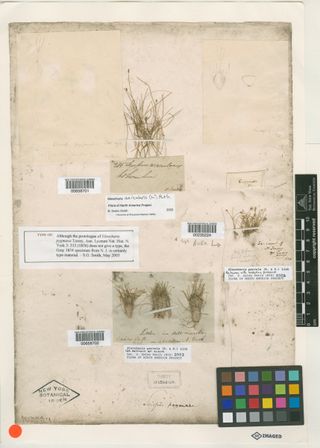
To New York Botanical Garden Steere Herbarium (Eleocharis_pygmaea_NY235224_type_1) (from synonym Eleocharis pygmaea Torr.)
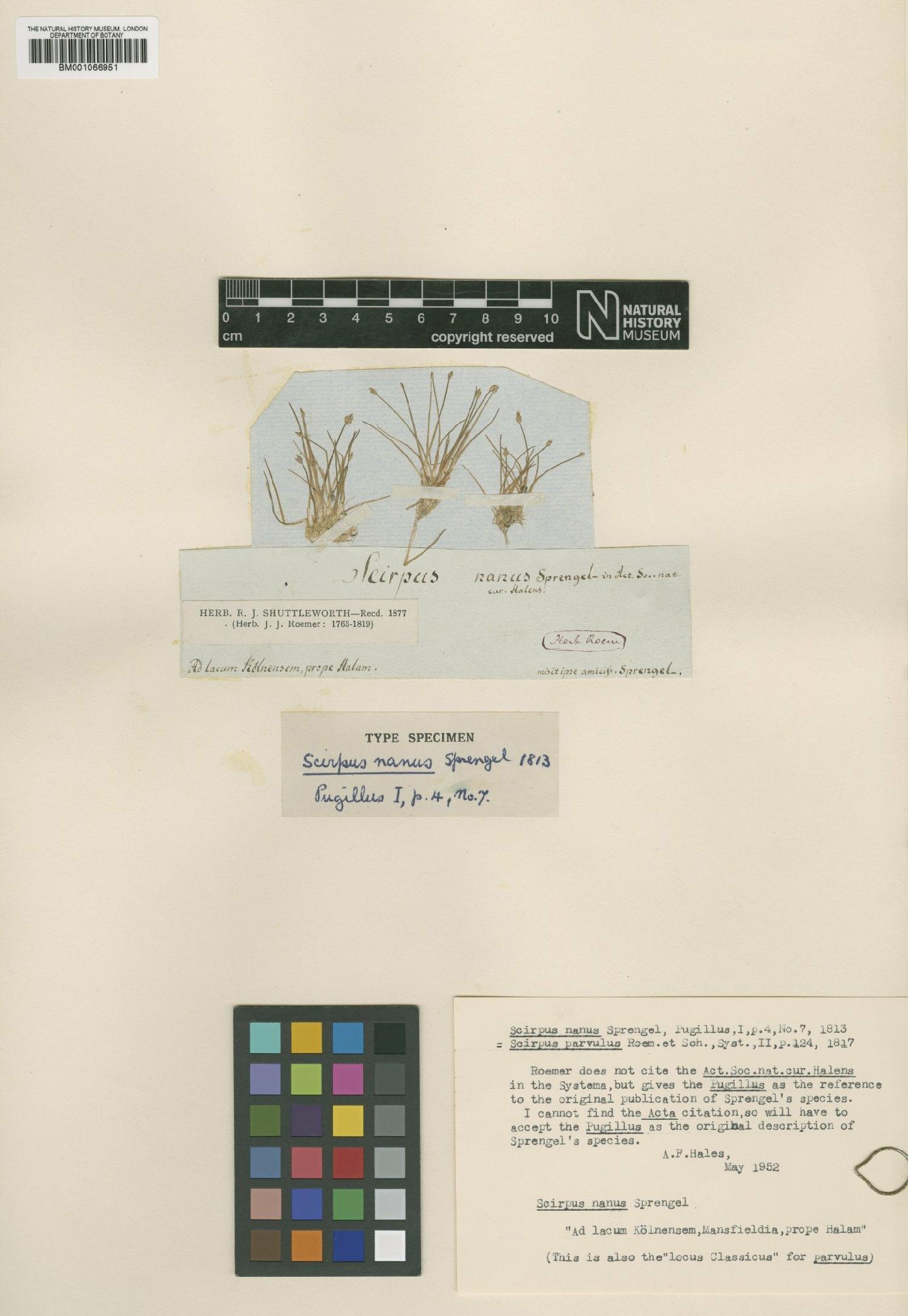
To NHMUK collection (Eleocharis parvula (Roem. & Schult.) Link ex Bluff, Nees & Schauer; Type; NHMUK:ecatalogue:2242121)
To Plants of the World Online
To Plants of the World Online (from synonym Chaetocyperus membranaceus Buckley)
To Plants of the World Online (from synonym Baeothryon nanum A.Dietr.)
To Plants of the World Online (from synonym Clavula comosa Dumort.)
To Plants of the World Online (from synonym Chaetocyperus pygmaeus (Torr.) Torr. ex A.Gray)
To Plants of the World Online (from synonym Chaetocyperus pusillus Steud.)
To Plants of the World Online (from synonym Cyperus parvulus Missbach & E.H.L.Krause)
To Plants of the World Online (from synonym Eleocharis membranacea (Buckley) Gilly)
To Plants of the World Online (from synonym Eleocharis leptos (Steud.) Svenson)
To Plants of the World Online (from synonym Eleogiton parvula Link)
To Plants of the World Online (from synonym Eleocharis pygmaea Torr.)
To Plants of the World Online (from synonym Scirpus nanus Spreng.)
To Plants of the World Online (from synonym Limnochloa parvula Rchb.)
To Plants of the World Online (from synonym Isolepis leptos Steud.)
To Plants of the World Online (from synonym Scirpus leptos (Steud.) C.Wright)
To Plants of the World Online (from synonym Scirpus comosus (Dumort.) B.D.Jacks.)
To Plants of the World Online (from synonym Eleocharis parvula subsp. oppermannii Zoz)
To Plants of the World Online (from synonym Scirpus parvulus Roem. & Schult.)
To Plants of the World Online (from synonym Trichophorum parvulum (Roem. & Schult.) Pignatti)
To Plants of the World Online (from synonym Scirpus pollicaris Delile)
To Plants of the World Online (from synonym Eleocharis parvula f. spongiosa Fassett)
To Plants of the World Online (from synonym Eleocharis leptos var. johnstonii Svenson)
To the Natural History Museum, London (Eleocharis parvula (Roem. & Schult.) Link ex Bluff, Nees & Schauer BM001066951 type 1)
To The Plant List (from synonym Scirpus comosus Dumort.)
To The Plant List (from synonym Eleocharis parvula (Roem. & Schult.) Palla)
To The Plant List (from synonym Eleocharis parvula var. parvula (Roem. & Schult.) Link ex Bluff, Nees & Schauer)
To The Plant List (from synonym Eleocharis parvula f. parvula (Roem. & Schult.) Link ex Bluff, Nees & Schauer)
To ITIS
To Biodiversity Heritage Library (11 publications) (from synonym Cyperus parvulus Missbach & E.H.L.Krause)
To Biodiversity Heritage Library (111 publications)
To Biodiversity Heritage Library (111 publications) (from synonym Eleocharis parvula (Roem. & Schult.) Palla)
To Biodiversity Heritage Library (17 publications) (from synonym Baeothryon nanum A.Dietr.)
To Biodiversity Heritage Library (174 publications) (from synonym Scirpus nanus Spreng.)
To Biodiversity Heritage Library (19 publications) (from synonym Scirpus comosus (Dumort.) B.D.Jacks.)
To Biodiversity Heritage Library (19 publications) (from synonym Scirpus comosus Dumort.)
To Biodiversity Heritage Library (2 publications) (from synonym Eleocharis membranacea (Buckley) Gilly)
To Biodiversity Heritage Library (22 publications) (from synonym Eleogiton parvula Link)
To Biodiversity Heritage Library (290 publications) (from synonym Scirpus parvulus Roem. & Schult.)
To Biodiversity Heritage Library (3 publications) (from synonym Eleocharis leptos (Steud.) Svenson)
To Biodiversity Heritage Library (36 publications) (from synonym Limnochloa parvula Rchb.)
To Biodiversity Heritage Library (5 publications) (from synonym Chaetocyperus membranaceus Buckley)
To Biodiversity Heritage Library (6 publications) (from synonym Scirpus leptos (Steud.) C.Wright)
To Biodiversity Heritage Library (7 publications) (from synonym Scirpus pollicaris Delile)
To Biodiversity Heritage Library (7 publications) (from synonym Clavula comosa Dumort.)
To Biodiversity Heritage Library (8 publications) (from synonym Isolepis leptos Steud.)
To Biodiversity Heritage Library (91 publications) (from synonym Eleocharis pygmaea Torr.)
To Dyntaxa
To European Nucleotide Archive, ENA (Eleocharis parvula)
To European Nucleotide Archive, ENA (Eleocharis parvula) (from synonym Eleocharis parvula (Roem. & Schult.) Palla)
To International Plant Names Index (IPNI) (from synonym Eleocharis parvula (Roem. & Schult.) Palla)
To International Plant Names Index (IPNI) (from synonym Scirpus comosus Dumort.)
To International Plant Names Index (IPNI)
To International Plant Names Index (IPNI) (from synonym Clavula comosa Dumort.)
To International Plant Names Index (IPNI) (from synonym Cyperus parvulus Missbach & E.H.L.Krause)
To International Plant Names Index (IPNI) (from synonym Baeothryon nanum A.Dietr.)
To International Plant Names Index (IPNI) (from synonym Chaetocyperus membranaceus Buckley)
To International Plant Names Index (IPNI) (from synonym Chaetocyperus pusillus Steud.)
To International Plant Names Index (IPNI) (from synonym Chaetocyperus pygmaeus (Torr.) Torr. ex A.Gray)
To International Plant Names Index (IPNI) (from synonym Eleocharis pygmaea Torr.)
To International Plant Names Index (IPNI) (from synonym Eleogiton parvula Link)
To International Plant Names Index (IPNI) (from synonym Eleocharis leptos (Steud.) Svenson)
To International Plant Names Index (IPNI) (from synonym Eleocharis membranacea (Buckley) Gilly)
To International Plant Names Index (IPNI) (from synonym Isolepis leptos Steud.)
To International Plant Names Index (IPNI) (from synonym Limnochloa parvula Rchb.)
To International Plant Names Index (IPNI) (from synonym Scirpus nanus Spreng.)
To International Plant Names Index (IPNI) (from synonym Scirpus parvulus Roem. & Schult.)
To International Plant Names Index (IPNI) (from synonym Trichophorum parvulum (Roem. & Schult.) Pignatti)
To International Plant Names Index (IPNI) (from synonym Scirpus pollicaris Delile)
To International Plant Names Index (IPNI) (from synonym Scirpus leptos (Steud.) C.Wright)
To International Plant Names Index (IPNI) (from synonym Eleocharis parvula subsp. oppermannii Zoz)
To International Plant Names Index (IPNI) (from synonym Eleocharis leptos var. johnstonii Svenson)
To International Plant Names Index (IPNI) (from synonym Scirpus comosus (Dumort.) B.D.Jacks.)
To International Plant Names Index (IPNI) (from synonym Eleocharis parvula f. spongiosa Fassett)
To New York Botanical Garden Steere Herbarium (Eleocharis_pygmaea_NY235224_type_1) (from synonym Eleocharis pygmaea Torr.)
To NHMUK collection (Eleocharis parvula (Roem. & Schult.) Link ex Bluff, Nees & Schauer; Type; NHMUK:ecatalogue:2242121)
To Plants of the World Online
To Plants of the World Online (from synonym Chaetocyperus membranaceus Buckley)
To Plants of the World Online (from synonym Baeothryon nanum A.Dietr.)
To Plants of the World Online (from synonym Clavula comosa Dumort.)
To Plants of the World Online (from synonym Chaetocyperus pygmaeus (Torr.) Torr. ex A.Gray)
To Plants of the World Online (from synonym Chaetocyperus pusillus Steud.)
To Plants of the World Online (from synonym Cyperus parvulus Missbach & E.H.L.Krause)
To Plants of the World Online (from synonym Eleocharis membranacea (Buckley) Gilly)
To Plants of the World Online (from synonym Eleocharis leptos (Steud.) Svenson)
To Plants of the World Online (from synonym Eleogiton parvula Link)
To Plants of the World Online (from synonym Eleocharis pygmaea Torr.)
To Plants of the World Online (from synonym Scirpus nanus Spreng.)
To Plants of the World Online (from synonym Limnochloa parvula Rchb.)
To Plants of the World Online (from synonym Isolepis leptos Steud.)
To Plants of the World Online (from synonym Scirpus leptos (Steud.) C.Wright)
To Plants of the World Online (from synonym Scirpus comosus (Dumort.) B.D.Jacks.)
To Plants of the World Online (from synonym Eleocharis parvula subsp. oppermannii Zoz)
To Plants of the World Online (from synonym Scirpus parvulus Roem. & Schult.)
To Plants of the World Online (from synonym Trichophorum parvulum (Roem. & Schult.) Pignatti)
To Plants of the World Online (from synonym Scirpus pollicaris Delile)
To Plants of the World Online (from synonym Eleocharis parvula f. spongiosa Fassett)
To Plants of the World Online (from synonym Eleocharis leptos var. johnstonii Svenson)
To the Natural History Museum, London (Eleocharis parvula (Roem. & Schult.) Link ex Bluff, Nees & Schauer BM001066951 type 1)
To The Plant List (from synonym Scirpus comosus Dumort.)
To The Plant List (from synonym Eleocharis parvula (Roem. & Schult.) Palla)
To The Plant List (from synonym Eleocharis parvula var. parvula (Roem. & Schult.) Link ex Bluff, Nees & Schauer)
To The Plant List (from synonym Eleocharis parvula f. parvula (Roem. & Schult.) Link ex Bluff, Nees & Schauer)
To ITIS
From editor or global species database